
Everything Drifts
Part 2 of 7: After the Data
Ask anyone in their late 20s or early 30s how they got here, and chances are you’ll hear some version of: “I didn’t exactly plan it this way.”
Not unhappily. Just - with genuine confusion.
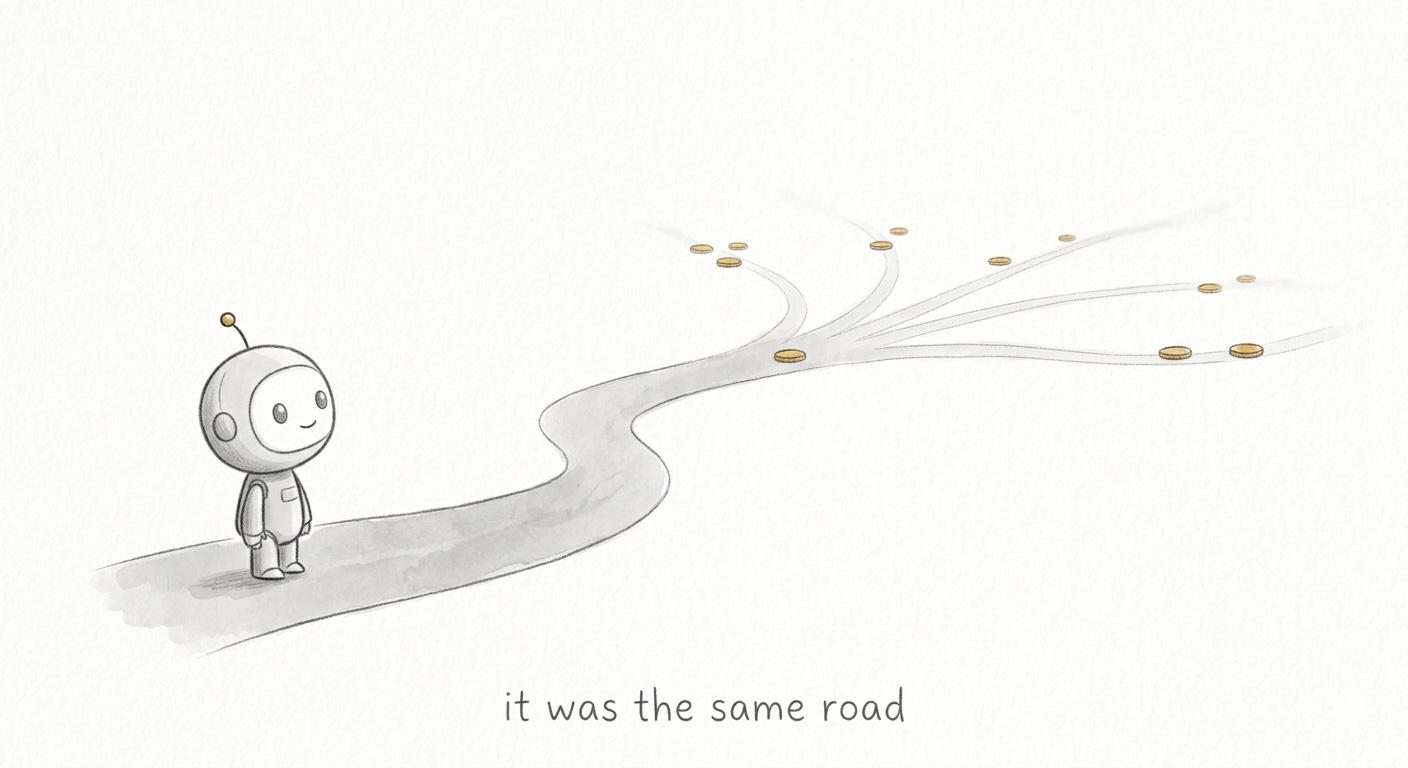
They made sensible decisions. Each one individually made sense. Take the better offer. Move to the bigger city. Stay at the company a bit longer. Say yes to the promotion.
And then one day they look up and realize the life they’re living is operating on a set of assumptions they never consciously chose.
What success means to them. What they actually want from work. What kind of person they’re trying to become.
Those things drifted. Slowly. Without announcement.
Nobody decided to diverge from their original intentions. It just happened - in the gap between decisions, in the space between one chapter and the next.
I think about that pattern a lot. Because it shows up everywhere.
Drift is the default
Drift isn’t a failure mode. It’s the natural state of complex systems.
Languages drift from their original forms. Scientific fields drift from their founding questions. Friendships drift from the people who started them.
In every case the mechanism is the same.
The original shared understanding (the definition, the assumption, the rule) was created in a specific moment. By specific people. For a specific context.
Then the context changed.
New people joined who weren’t there for the original conversation. The environment shifted in ways nobody anticipated. The thing that the original assumption was responding to quietly evolved into something different.
But the assumption didn’t update.
So the system kept running. On outdated logic. Getting slightly more misaligned with reality every day.
Until something forced a reckoning.
The organizational version :)
Companies are not immune to this. They’re actually unusually vulnerable to it.
Here’s why.
A company is essentially a large group of people trying to coordinate around shared assumptions. What we’re building. Who we’re building it for. How we measure success. What we’re willing to trade off.
In the early days those assumptions are held by a small group of people who talk constantly. Drift gets corrected in real time because everyone is close enough to notice when something’s off.
But companies don’t stay small.
They add people. Functions. Geographies. Products. Tools.
And every addition creates more distance between the people who hold the original assumptions and the systems and teams that depend on them.
The ICP that the founders defined in Y1 gets encoded in a CRM field, referenced in a slide deck, trained into a sales playbook, embedded in a targeting algorithm. Each translation introduces a small distortion.
The metric definition that finance and RevOps agreed on in a meeting two years ago gets implemented slightly differently in two different tools. Each tool gets queried by different teams. Each team builds on top of their version.
The strategic narrative that leadership aligned on in an offsite gets filtered through product marketing, then through sales enablement, then through individual rep interpretation. Each layer adds a small delta.
None of these individual drifts is catastrophic. Each one is just a small divergence from the original shared understanding.
But they compound.
And at some point the org is no longer operating on shared assumptions at all. It’s operating on a distributed set of slightly incompatible versions of what was once a single idea.
The moment you notice
It rarely surfaces as a crisis. It surfaces as friction.
A meeting where two teams can’t agree on a number - not because either is wrong, but because they’re calculating from different definitions.
A new hire who asks a simple question like “what does our ideal customer look like?” and gets three different answers from three different people.
A strategy document that says one thing and a CRM that reflects something subtly different.
An AI tool that gives an answer that’s technically correct but operationally useless because it was grounded in assumptions that haven’t been true for six months.
Each of these moments has the same root cause.
The shared understanding drifted. And nobody caught it.
Why we don’t catch it
The honest answer is that catching drift is nobody’s job. In a company, everyone has a function. Sales closes deals. Marketing generates pipeline. Finance models the business. RevOps manages the systems.
But nobody is responsible for maintaining the coherence of the assumptions that all of those functions depend on.
It’s not that people don’t care. It’s that the work of maintaining shared understanding is invisible. It doesn’t show up in a job description. It doesn’t get measured. It doesn’t get rewarded.
So it doesn’t get done.
Until it becomes painful enough that someone (usually an overextended RevOps leader or a frustrated finance analyst or a bewildered new executive) takes it on manually.
They call a meeting. They align the definitions. They update the documentation. They get everyone on the same page.
And then six months later, it drifts again.
Because the meeting was a fix. Not a system.
The career version
I said at the start that this pattern shows up everywhere. Let me come back to that.
The people I described at the beginning (the ones who don’t know how they ended up where they are) aren’t victims of bad decisions.
They’re victims of unmanaged drift.
They set an intention once. Maybe explicitly, maybe just implicitly. “This is what I’m optimizing for. This is what success looks like. This is what I’m willing to trade off.”
And then they made a hundred subsequent decisions without ever checking whether those decisions were still aligned with the original intention.
The assumption drifted. The decisions didn’t adapt.
The same thing happens in organizations. The strategy gets set. The assumptions get defined. And then a hundred subsequent decisions get made (about hiring, about product, about pricing, about who to target) without anyone checking whether those decisions are still aligned with the original logic.
In both cases the fix isn’t more discipline. It isn’t more meetings. It isn’t a better documentation process.
It’s a different relationship with the assumptions themselves.
One where maintaining coherence isn’t a one-time event but an ongoing practice. Where drift gets caught early rather than discovered late. Where the logic that governs the system is treated as something worth maintaining - not just something worth creating.
In organizations, that’s an infrastructure problem.
Nobody has built the infrastructure yet.
What’s coming
In the next issue I want to show you exactly where organizational drift shows up most painfully right now.
Not abstractly. In the specific places where companies are hitting walls they can’t explain, and discovering that the walls aren’t made of bad data or bad strategy.
They’re made of assumptions that quietly stopped being true.
Part 3 drops next week.
Until then,
— Adnan
P.S. Have a question or topic in mind? Drop it in the comments.
P.P.S. If this resonated, subscribe + follow on LinkedIn for more.